From Fractured Canvas to Living Code: a visual story of art, 1870–2026
How art changed from Impressionism to Cubism, Surrealism, Pop Art, street art and AI — a picture-led story of 150 years of painting, with where to see each famous work.
13 November 2026
Over the last 150 years, art broke free from being a realistic mirror of the world. Artists fractured perspective, painted raw dreams, turned soup cans into icons and eventually began working with algorithms. Each era links to the real painting on the museum's own website, so you can see the original. Most of these works are still under copyright, so we link to them rather than copy them.
1870–1899 · Prologue: Painters step into the light
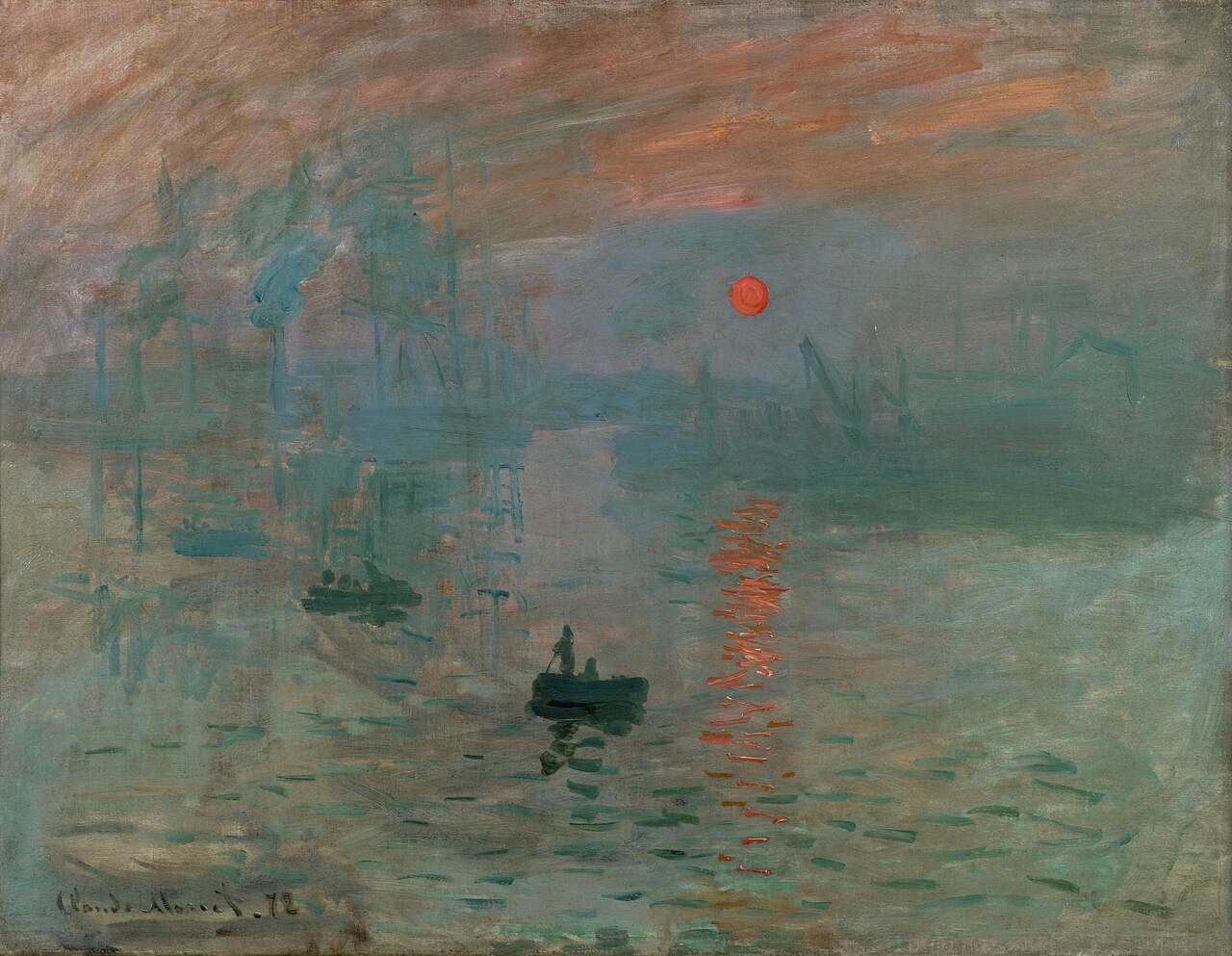
Before 1900, painters still made careful, polished pictures for academies and rich patrons. Then portable paint tubes and the new camera changed everything. Monet, Renoir and Van Gogh carried easels outdoors and painted light itself — quick, visible brushstrokes that caught a moment rather than copying every detail.
- Key words
- Light, Colour, Brushstroke, Outdoors
- Featured artist
- Claude Monet
- Famous work
- Impression, Sunrise (1872)
- See the real painting
- Musée Marmottan Monet, Paris ↗
1900–1919 · Breaking the rules of reality
Cameras could now capture realistic images, so painters stopped trying to copy nature. Instead, they shattered objects into sharp geometric angles and used wild, unnatural colours to express raw emotion.
- Key words
- Perspective, Fractured, Emotion, Rebellion
- Featured artist
- Pablo Picasso
- Famous work
- Les Demoiselles d'Avignon (1907)
- See the real painting
- Museum of Modern Art (MoMA), New York ↗
1920–1939 · Dreams, logic and the subconscious
After the trauma of the First World War, artists turned inward to explore dreams and the unconscious mind. Everyday objects melted, floated and twisted into uncanny landscapes that challenged human logic.
- Key words
- Subconscious, Dreamlike, Uncanny, Illusion
- Featured artist
- Salvador Dalí
- Famous work
- The Persistence of Memory (1931)
- See the real painting
- Museum of Modern Art (MoMA), New York ↗
1940–1959 · Pure gesture and monumental scale
After the Second World War, the centre of the art world moved to New York, and painters dropped recognisable subjects altogether. Artists laid huge canvases on the floor, dripping and pouring paint so the act of making became the art itself.
- Key words
- Spontaneity, Scale, Gesture, Abstraction
- Featured artist
- Jackson Pollock
- Famous work
- Autumn Rhythm (Number 30) (1950)
- See the real painting
- The Metropolitan Museum of Art, New York ↗
1960–1979 · Mass media and everyday icons
As television and advertising flooded daily life, Pop artists blurred the line between museums and supermarket shelves. With bright commercial colours and screen-printing, they turned soup cans, comic strips and celebrities into fine art.
- Key words
- Consumerism, Irony, Mass Media, Repetition
- Featured artist
- Andy Warhol
- Famous work
- Campbell's Soup Cans (1962)
- See the real painting
- Museum of Modern Art (MoMA), New York ↗
1980–1999 · Street energy and identity
Art spilled out of white-walled galleries onto city streets, subway trains and brick walls. Mixing graffiti, poetry, social comment and bold brushwork, artists confronted race, power and city life head-on.
- Key words
- Identity, Urban, Graffiti, Confrontation
- Featured artist
- Jean-Michel Basquiat
- Famous work
- Untitled (1981)
- See the real painting
- The Broad, Los Angeles ↗
2000–2026 · Algorithms, immersion and living data
In the twenty-first century the artist's brush grew to include code, sensors and artificial intelligence. Giant digital sculptures now turn live data and museum archives into shifting worlds that respond to viewers in real time.
- Key words
- Algorithms, Immersion, Data, Hyper-Connectivity
- Featured artist
- Refik Anadol
- Famous work
- Unsupervised (2022)
- See the real painting
- Museum of Modern Art (MoMA), New York ↗
Today and beyond · The independent artist
For most of history, artists needed a dealer, a patron or a gallery to be seen — and gave away up to half of every sale. Today a painter in a small Yorkshire studio can share their work with the whole world from a phone.
That's why artistgallery exists: real paintings by living artists, sold directly, with 0% commission. The next chapter of art history is being painted right now — and you can own a piece of it.
Every great movement started with artists nobody had heard of yet.
Find a painting you'll love
Browse original paintings and contact independent artists directly — 0% commission.